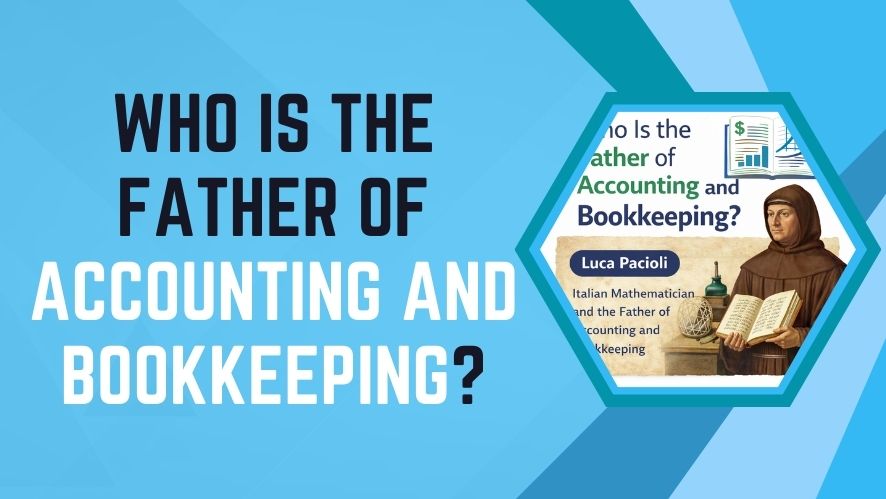
If you are searching for the father of accounting and bookkeeping, the answer most historians agree on is Luca Pacioli. His famous book Summa de Arithmetica (Venice, 1494) contains the first printed explanation of the double-entry bookkeeping system used by merchants in Venice. This system became the foundation of modern accounting and financial accounting.
Corporate accounting practices used by every accountant, CPA, and chartered accountant today. Although earlier merchants were already using similar methods, Pacioli documented and taught the system in a way that made bookkeeping structured, repeatable, and easier to learn. This is why he is widely referred to as the father of accounting and bookkeeping.
A Quick Life of Luca Pacioli
Luca Pacioli was born around 1445 in Borgo Sansepolcro, Italy, and died in 1517. He was a mathematician, teacher, and later a Franciscan friar. Throughout his career, he taught mathematics and accountancy concepts in cities like Perugia and Venice. His teaching helped merchants and early book keepers understand systematic methods for maintaining ledger account records, tracking account receivable, and managing account payable.
His most famous work, Summa de Arithmetica, Geometria, Proportioni et Proportionalita (1494), includes a section called “De Scripturis”, which explains how merchants should maintain journals, ledgers, and a profit and loss account. Later, in 1509, Pacioli published Divina Proportione, illustrated by Leonardo da Vinci, which expanded his reputation beyond accounting into mathematics and geometry.
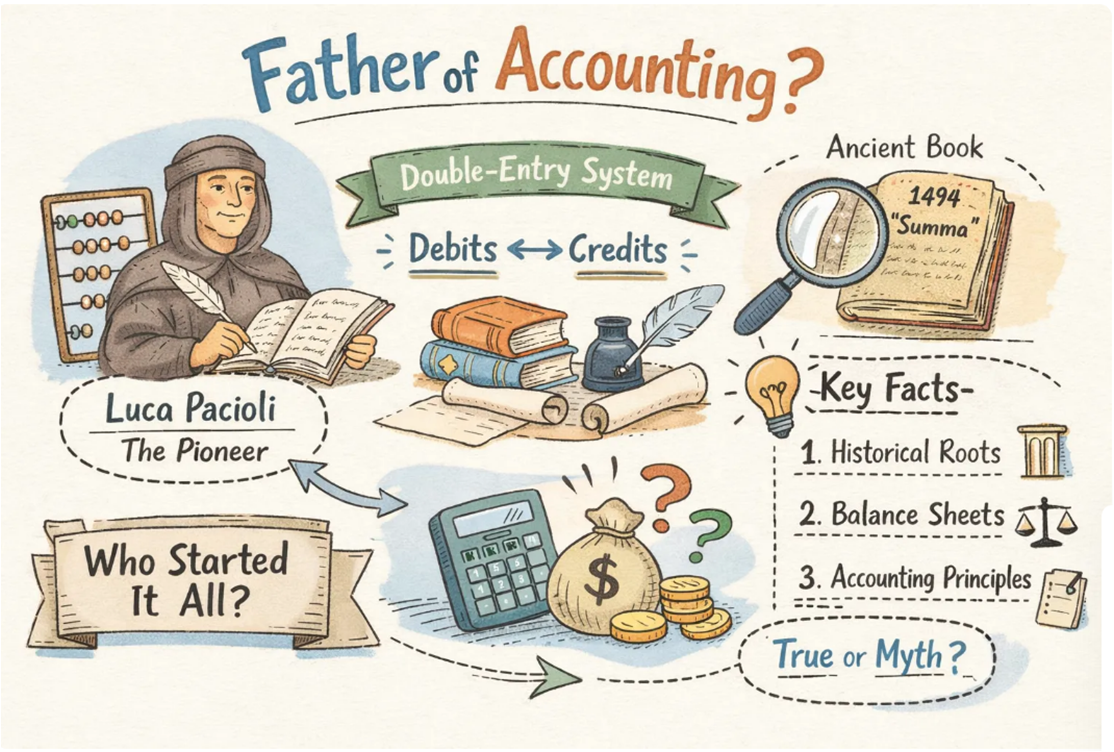
What the 1494 Summa Says About Accounting and Bookkeeping
The section “De Scripturis” in Summa de Arithmetica describes the basic system that modern accounting and bookkeeping still follows today.
Pacioli explained how merchants should maintain:
- A daybook for recording daily transactions
- A ledger account for organizing financial data
- A trial balance to ensure records are accurate
These principles are still used in modern accounting software’s and professional systems used by CPAs, chartered accountants, and tax advisors near me.
The three core ideas he described include:
- Dual-Aspect Principle
Every financial transaction has two sides. This is the foundation of double-entry accounting. - Debit and Credit System
He famously wrote: “Place creditors on the right and debtors on the left.”
This rule is still used today in systems such as Tally ERP 9, ZohoBooks, and AlignBooks. - Trial Balance Verification
Before closing accounts, merchants should verify that totals match. This step ensures the accuracy of financial accounting records.
Did Double-Entry Bookkeeping Exist Before Pacioli?
Historical evidence shows that forms of double-entry bookkeeping existed before Pacioli’s book. Surviving merchant records from Mediterranean trade show similar methods of maintaining ledger account, account receivable, and account payable.
Some historians credit earlier merchants and writers such as Benedetto Cotrugli for discussing similar methods before 1494.
Because of this evidence, historians usually describe Pacioli as a compiler and teacher rather than the sole inventor of modern accountancy. His major contribution was organizing and publishing these methods so they could be widely learned by merchants and professional book keepers.
Why Pacioli’s Accounting Principles Still Matter Today
Even today, the same principles form the backbone of management accounting, cost accounting, and corporate accounting.
Modern businesses—from small startups to global companies audited by the Big Four—still rely on the same double-entry system.
The Big Four accounting firms include:
- Deloitte
- PwC
- Ernst & Young
- KPMG
These firms and millions of professional accountants, CPAs, and chartered accountants near me rely on modern accounting software that still follow the same double-entry rules.
Double-Entry Accounting and Bookkeeping in Modern Software
Modern accounting and bookkeeping software automates many of the processes originally described by Pacioli. Platforms such as Tally ERP9, ZohoBooks, and AlignBooks automatically maintain balanced journals, update ledger account records, and generate profit and loss account reports.
These tools help businesses manage:
- Account receivable tracking
- Account payable management
- GST and tax calculations
- Automated financial reporting
Because of these systems, today’s book keepers, accountants, and tax advisors near me can focus more on strategy and less on manual calculations.
How Modern Businesses Use Accounting and Bookkeeping Today
Today, bookkeeping and financial accounting are essential for business success. Proper financial records help companies:
- Track payable and receivables accurately
- Maintain a clear profit and loss account
- Improve management accounting decisions
- Control expenses through cost accounting
- Prepare tax filings with a chartered accountant
For small businesses and startups, working with professionals or reliable accounting systems can significantly improve financial transparency.
Conclusion
Although Luca Pacioli did not invent double-entry accounting, his work in 1494 documented and explained the system that shaped modern accountancy. Today, the same principles guide everything from small-business bookkeeping to global corporate accounting managed by the Big Four accounting firms.
Modern software like Tally ERP 9, ZohoBooks, and AlignBooks simply automate the rules Pacioli explained more than 500 years ago. Understanding these fundamentals helps business owners, accountants, and CPAs maintain accurate financial records and make better financial decisions.
FAQs – Who is the father of accounting and bookkeeping?
Q1. Who is known as the father of accounting and bookkeeping?
Ans. Luca Pacioli is widely known as the father of accounting and bookkeeping for documenting the double-entry system in 1494.
Q2. What book made Luca Pacioli famous in accounting?
Ans. Luca Pacioli explained the double-entry bookkeeping system in his book Summa de Arithmetica, which became the foundation of modern accounting.
Q3. What is double-entry bookkeeping?
Ans. Double-entry bookkeeping is a system where every financial transaction is recorded in two accounts—debit and credit—to maintain balanced financial records.
Q4. Why is Luca Pacioli important in modern accounting?
Ans. He documented and organized bookkeeping practices, which are still used today by accountants, CPAs, and chartered accountants worldwide.
Q5. Is the double-entry system still used today?
Ans. Yes, modern accounting software and professional accountants still follow the double-entry bookkeeping system introduced by Luca Pacioli.